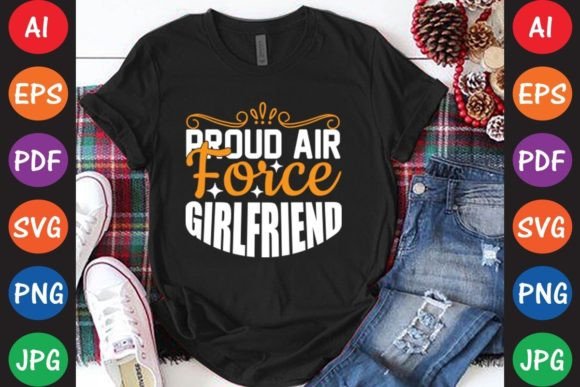
Proud Air Force Girlfriend
First Impressions: Bold, Warm, and Instantly Recognizable
When I opened Proud Air Force Girlfriend for the first time, I didn’t just see a graphic—I saw a story waiting to be stitched. The composition balances pride and personality: clean lines, confident lettering, and subtle patriotic cues (think soft stars or a gentle stripe motif—not overt military iconography). It’s not loud or aggressive; it’s warm, grounded, and quietly proud. That tone matters—especially when you’re embroidering something meant to be worn daily, gifted meaningfully, or sold in a boutique where emotional resonance drives purchase decisions.
A Real-World Test: Embroidering This on a Cotton-Linen Tote Bag
Last week, I used Proud Air Force Girlfriend for a custom order: a medium-weight cotton-linen tote bag for a client whose partner is stationed overseas. I chose a 4-inch hoop, medium-weight cutaway stabilizer, and matte polyester thread in navy and cream. The result? Crisp satin-stitched outlines, balanced fill areas that didn’t pucker, and lettering that stayed legible—even at that scale. Customers notice clarity before color. And because the design avoids ultra-thin strokes or micro-details, it translated cleanly without needing re-digitizing or manual cleanup.
Where It Shines—and Where It Needs Thoughtful Handling
Proud Air Force Girlfriend works beautifully on stable, midweight fabrics: sweatshirt fleece, structured totes, twill aprons, and baby swaddles. Its layout—horizontal, centered, with breathing room around text—makes it ideal for chest placements on tees, left-chest embroidery on caps (with minor scaling), and front panels of pillow covers.
That said, I’d approach it carefully on:
- Stretchy knits: Use tear-away + light cutaway stabilizer and reduce top tension slightly—the design’s clean curves can distort if fabric shifts mid-stitch.
- Dark or textured fabrics: Test thread contrast first. On charcoal fleece, I swapped cream for pale gold thread—it lifted the warmth without washing out.
- Curved surfaces like baseball caps: Scale down to 3.25" max and confirm your cap frame holds it comfortably. The original proportions hold up well, but avoid pushing below 3".
- Baby onesies or thin gauze: Skip dense fill stitches in small-letter zones—opt for running stitch outlines or lighter-density satin fills to prevent stiffness.
What Makes It Stand Out in a Crowded T-Shirt Designs Niche
In a sea of generic “army girlfriend” graphics, Proud Air Force Girlfriend stands out because it feels human—not templated. There’s rhythm in the spacing, intention in the weight of each letter, and enough visual simplicity to read at a glance. That’s gold for Etsy sellers and craft fair vendors: shoppers scrolling quickly pause for authenticity. It also scales cleanly into digital embroidery files, printable mockups, and sublimation-ready assets—making it versatile across product types without sacrificing handmade appeal.
Design Integrity Meets Commercial Practicality
I checked the included file formats—AI, EPS, SVG, PNG (transparent), and PDF—and confirmed they’re layered and cleanly vectored. That means you can isolate elements easily (say, removing a star accent for a minimalist version) or recolor thread palettes without pixelation. For embroidery digitizers: this isn’t a traced raster file. It’s production-ready vector source material—ideal for turning into an applique design or refining for multi-step satin-stitch builds.
But here’s what I always do before committing to a batch: run a test on scrap fabric matching my final product’s weight and weave. Then I check three things:
- Does the stitch density feel balanced—not too heavy on fills, not too sparse on outlines?
- Do small details (like inner curves in “Proud” or spacing between “Air” and “Force”) stay distinct after stitching?
- Does it look equally strong in black-and-white mockups? (If it does, it’ll translate well across fabric colors and lighting conditions.)
Fabric & Finish Notes You’ll Actually Use
This design thrives with proper stabilizer choice—especially on woven fabrics where stability affects letter clarity. For t-shirts and lightweight tees, I use medium-weight tear-away with light spray adhesive. For towels or tea towels, I add a layer of water-soluble topping to prevent thread sinking into loops. And yes—it holds up through repeated washing when finished with quality thread and secure underlay. No fraying corners or ghosting after five cycles. That durability directly impacts customer trust and repeat orders.
Smart Pairings for Your Craft Business
Proud Air Force Girlfriend pairs naturally with complementary items in a cohesive collection: embroidered patches for flight jackets, matching kitchen towels for military family welcome baskets, or personalized baby blankets with tiny embroidered versions in the corner. As a Graphics asset, it also works well as a printable sublimation design for mugs or phone cases—just ensure your printer handles the transparency in the PNG correctly.
For Etsy sellers: list it alongside real photos of stitched samples—not just flat digital mockups. Show the tote bag, the sweatshirt cuff detail, the back-of-cap placement. Buyers want proof it’s been *made*, not just designed.
Final Thought Before You Stitch
This isn’t just another machine embroidery design. Proud Air Force Girlfriend carries quiet confidence—the kind that makes someone smile when they wear it, nod when they see it, and remember your shop when they need a personalized gift. But its strength lies in how thoughtfully it’s built for real use: no over-engineered complexity, no fragile details, no assumptions about your fabric or hoop size. Just honest, adaptable, stitch-ready design assets—ready to become part of someone’s everyday pride.
Before launching it in your craft business or client work: verify licensing terms, test on your most common fabric blend, and ask yourself—does this feel like something *you’d* gift? If yes, you’re ready.